
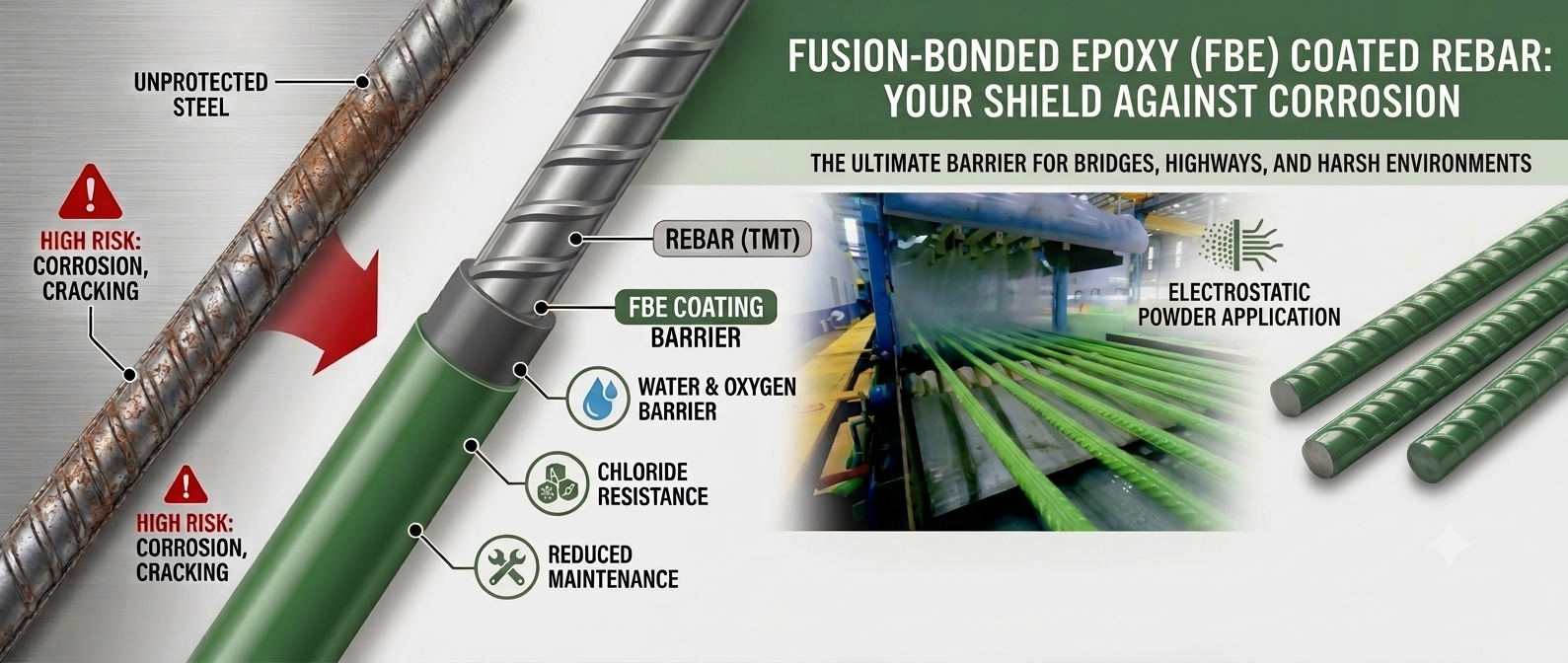
The most commonly used building material is concrete reinforced with steel bars. Concrete is reinforced with rebar or steel reinforcing bars for strength and stability. Concrete provides some protection for steel but over time, rebar can corrode when exposed to moisture, oxygen, chlorides and other aggressive substances.
Corrosion can cause the steel to expand, which can result in cracking, spalling and weakening of the concrete structure. One good way to reduce this risk is to apply fusion-bonded epoxy (FBE) coating on rebar. It also helps to increase the resistance of the steel to the corrosive environment by forming a protective coating around the steel.
01 WHAT IS A FUSION BONDED EPOXY COATING?
The steel is coated with a protective coating called fusion-bonded epoxy. The coating is heated and cured under controlled conditions. The prepared steel is electrostatically coated with the epoxy powder and heated to melt the powder and form a continuous protective film.
FBE bonds very well to the steel surface and is not just a paint coating. A properly cured coating forms a tough layer that protects the steel from external agents that cause corrosion.
FBE coated rebar is typically specified for structures to be located in harsh or wet environments such as:
- Bridges and highways
- Marine and coastal structures
- Parking structures
- Water treatment facilities
- Dams and other infrastructure
- Buildings exposed to de-icing salts
02 WHAT CAUSES REBAR CORROSION?
In a good quality concrete the steel is normally protected by the very alkaline environment in the concrete. The alkalinity passivates the steel. This means it forms a layer that helps prevent corrosion.
However, this protection may be reduced when the reinforcement is in contact with aggressive agents. For example, chloride ions are able to penetrate the concrete and can destroy the passive layer on the steel.
Carbon dioxide can also slowly decrease the alkalinity of concrete by a process called carbonation. When the conditions protecting the steel are lost, corrosion can start in the presence of moisture and oxygen.
Corrosion of rebar can lead to:
- Steel expansion
- Failure of concrete encasement
- Concrete spalling
- Reduction of steel cross section
- Reduced structural performance
- Increased maintenance and repair costs
An important part of the protection of reinforced concrete is to keep corrosive substances away from the steel.
03 HOW FBE COATING OFFERS A PROTECTIVE BARRIER
The main function of a fusion bonded epoxy coating is to serve as a barrier between steel and the environment.
The correct application of the epoxy layer will cover the rebar surface and reduce the direct contact between the steel and moisture, oxygen, chlorides and other corrosive elements.
The coating helps protect rebar by:
- Limiting moisture contact
- Reducing chloride penetration to the steel surface
- Separating steel from corrosive substances
- Providing resistance against many environmental conditions
- Helping maintain the integrity of the reinforcing steel
This barrier effect is especially helpful in structures where concrete might be exposed to salt water, road salts or persistent moisture.
04 GOOD ADHESION TO STEEL SURFACE
Fusion-bonded epoxy’s biggest advantage is that it offers good adhesion. The surface of the steel is thoroughly cleaned and prepared for coating, removing rust, mill scale, oil, dirt and other contaminations. Then the epoxy powder is applied and cooked. In this process the powder melts and flows over the prepared steel surface and cures to give a continuous coating.
Surface preparation is key and proper application will facilitate the epoxy bonding to the rebar. Good adhesion ensures that the coating sticks to the steel during handling, transportation, installation and service.
05 PROTECTION FROM CHLORIDE
The biggest problem with reinforced concrete is chlorides. This is especially true if your structure is near the ocean or in an area that uses de-icing salts. The chloride ions can pass through the concrete to the reinforcement. Once they reach the steel in sufficient concentration they can help with corrosion.
FBE coating also serves as a barrier and thus retards the penetration of chlorides to the steel. This can be particularly useful on infrastructure that is repeatedly exposed to chlorides.
But the quality of the coating is important. A good coating properly and evenly applied will give far better protection than one that is defective or damaged.
06 RESISTANCE TO ATMOSPHERIC AND MOISTURE CONDITIONS
Moisture has a strong influence on corrosion. The FBE coating acts as a barrier to avoid the external moisture affecting the steel surface, thus reducing the degree of corrosion. The coating also helps to protect from various environmental conditions during the service life of the structure.
Depending on the particular epoxy system and project requirements, important properties can be:
- Waterproof
- Chemical resistance
- Abrasion resistance
- Adhesiveness
- Durable
- Damage resistance handling
The actual performance of an FBE coating will vary depending on the formulation of the coating, the application process, the environmental conditions and quality control procedures.
07 PREPARATION OF THE SURFACE IS IMPORTANT
One of the most critical stages of FBE coating is surface preparation. Even the best quality epoxy product will not be able to provide reliable protection if the surface is not properly prepared.
The steel has to be properly cleaned and coated with an epoxy powder. Surface preparation typically consists of cleaning and the creation of a surface that is receptive to coating adhesion.
Some important steps can be:
- Surface preparation of rebar
- Rust, dirt, oil and other contaminants removal
- Abrasive surface preparation
- Inspect the prepared surface
- Epoxy powder application in controlled conditions
- Coating curing and heating
- Control of the final coating
Controlled procedures can produce a more uniform and durable coating.
08 HANDLING AND INSTALLATION IS ESSENTIAL
Rebars coated with FBE must be handled carefully to avoid compromising the coating and exposing the steel underneath. Be alert for scratching, cutting, impact or mishandling in any area where corrosive substances may contact metal. Handling of the material during transit needs to be done with utmost care and also by following clear protocols.
Construction teams must be aware of:
- Correct lifting and handling equipment
- Correct storage environment
- Not to cause undue impact or abrade
- Precise position of the formwork
- Visual check of damage to coatings before concrete placement
Damaged areas shall be repaired in accordance with the applicable project specifications and repair procedures.
CONCLUSION
The rebar is protected by fusion-bonded epoxy coatings that create a tough, continuous barrier between the steel and corrosive elements like moisture, oxygen and chlorides. Reliable protection depends on proper surface preparation, controlled coating application, curing, inspection and careful handling.
FBE-coated rebar can be an important component of a larger corrosion protection strategy for infrastructure exposed to aggressive environments. Selecting a reputable manufacturer and following the installation procedures properly will ensure that the coated reinforcement will be effective for the life of the structure.
 Contact us