
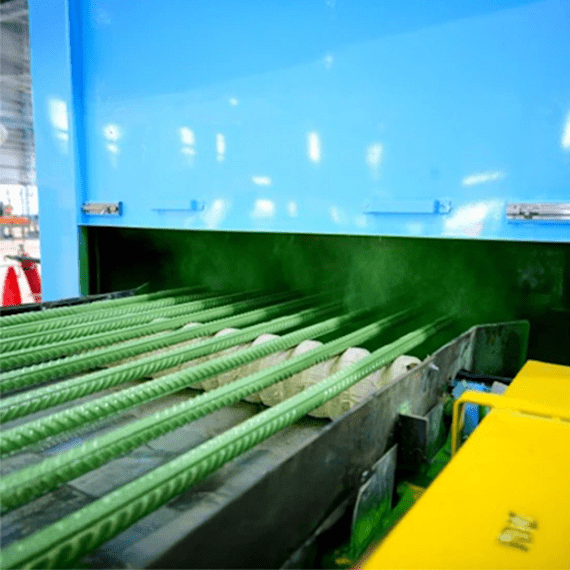
In India, the structure of reinforced concrete buildings is always put to the test due to the conditions of a high humidity level, extreme temperature changes, salinity on the coast, and the extreme level of air pollution. The most important thing is the corrosion protection of the steel rebar. Two eminent solutions to anti-corrosion include fusion-bonded epoxy (FBE) coating and polyvinyl chloride (PVC) coating. It is important to examine how the two types of coating perform under the environmental stressors unique to India in determining which is the better.
UNDERSTANDING THE OPTION: TECHNOLOGY AND APPLICATION
- Fusion-Bonded Epoxy (FBE): This involves electrostatically applying a thermosetting epoxy powder onto heated, cleaned steel rebar, which fuses into a continuous, chemically bonded film. It provides a passive barrier against moisture, chlorides, and oxygen.
- Polyvinyl Chloride (PVC) Coating: PVC is usually extruded as a heavy seamless coating over the rebar when it is over a galvanized or primer layer. It is a very strong physical barrier and has significant mechanical protection.
CORROSION RESISTANCE: THE PRIMARY BATTLE
- Epoxy Coating: Epoxy prevents chloride ion penetration, which is important in coastal and de-icing salt locations. Chemical adhesion creates a tight barrier. Even little handling damage might cause under film corrosion if moisture penetrates, making it difficult to detect.
- PVC Coating: PVC has a higher barrier thickness hence it is very resistant to attack by chloride and sulphate. Its smoothness and increased resistance to damage imply that small abrasions do not put the steel core at risk of being exposed to the environment. It is very functional in a constantly wet or submerged part of the environment like wastewater treatment plants or marine pilings.
The thicker and more impervious barrier that comes with PVC and the higher ability to withstand damage might give it a minor advantage in the extreme coastal and industrial areas of the Indian context.
MECHANICAL AND ON-SITE PERFORMANCE
- Epoxy Coating: The thin epoxy layer is susceptible to damage during transportation, bending, and placement on-site. It demands careful handling and repair of damaged spots with compatible epoxy paint—a step often neglected in Indian construction practices, compromising integrity.
- PVC Coating: With a much higher thickness compared to epoxy coating, PVC is significantly tougher and more abrasion-resistant. It withstands rough handling, bending, and vibration during concreting with far less risk of damage. This robustness is a major advantage in the fast-paced, often less-controlled Indian construction environment.
THERMAL AND UV CONSIDERATIONS
Indian Summers and UV Exposure: Epoxy coating is prone to chalking and degradation when subjected to the exposure of strong ultraviolet (UV) light and this is a fact in India. When they are left uncovered on the site after weeks, their performance may deteriorate. PVC is a thermoplastic which has a naturally superior UV and weather resistance when temporarily exposed.
BOND STRENGTH WITH CONCRETE
This is a very important structural parameter. Rebar that is epoxy-coated forms a bond strength low enough compared to uncoated rebar but is typically governed as sufficient in the design when construction rules are adhered to. However, because it has a smooth and non-porous surface, PVC-coated rebar has a considerably lower bond strength. This requires changes in design, like deformed PVC-coated bars or end anchors, which complicates and increases the expenditure.
COST AND LIFECYCLE ECONOMICS
Epoxy coating is generally the lower-cost option initially and is widely available in the Indian market. Its application technology is well-established. PVC coating commands a higher initial cost due to the material and application process. However, its durability, lower sensitivity to handling damage, and potentially longer maintenance-free service life in aggressive environments can lead to better lifecycle cost economics for critical, long-life infrastructure.
CONCLUSION
The two coatings provide better protection over uncoated rebar, but PVC coating is the more robust and reliable in the most extreme exposures in the Indian climate, especially the coastal region and the industrial area, as it has better barrier characteristics and resistance to damages. Its increased cost and restrictions on bond strength should, however, be designed. Epoxy coating is still a workhorse, a cost-effective and reliable coating to be used in a diversity of applications where environmental aggression is not extreme and unnecessary construction practices are not taken. The final call is to be taken based on a lifecycle cost analysis that factors in the specific microclimate, construction realities, and the intended design life of the structure.
Related Link: What Are The Disadvantages Of TMT Bars?
-
209, Gowra Fountainhead, Patrika Nagar
Madhapur, Hyderabad - 500081 - Phone: +91 9100073039 Phone: +91 8121004773
- nsepoxy@gmail.com Website: www.nagarjunagroup.com
- Sitemap
 Contact us
NS Epoxy stands as the frontrunner in TMT manufacturing, committed to constant innovation and research. Our focus is to ensure our product technology remains cutting-edge, precisely tailored to meet client's requirements.