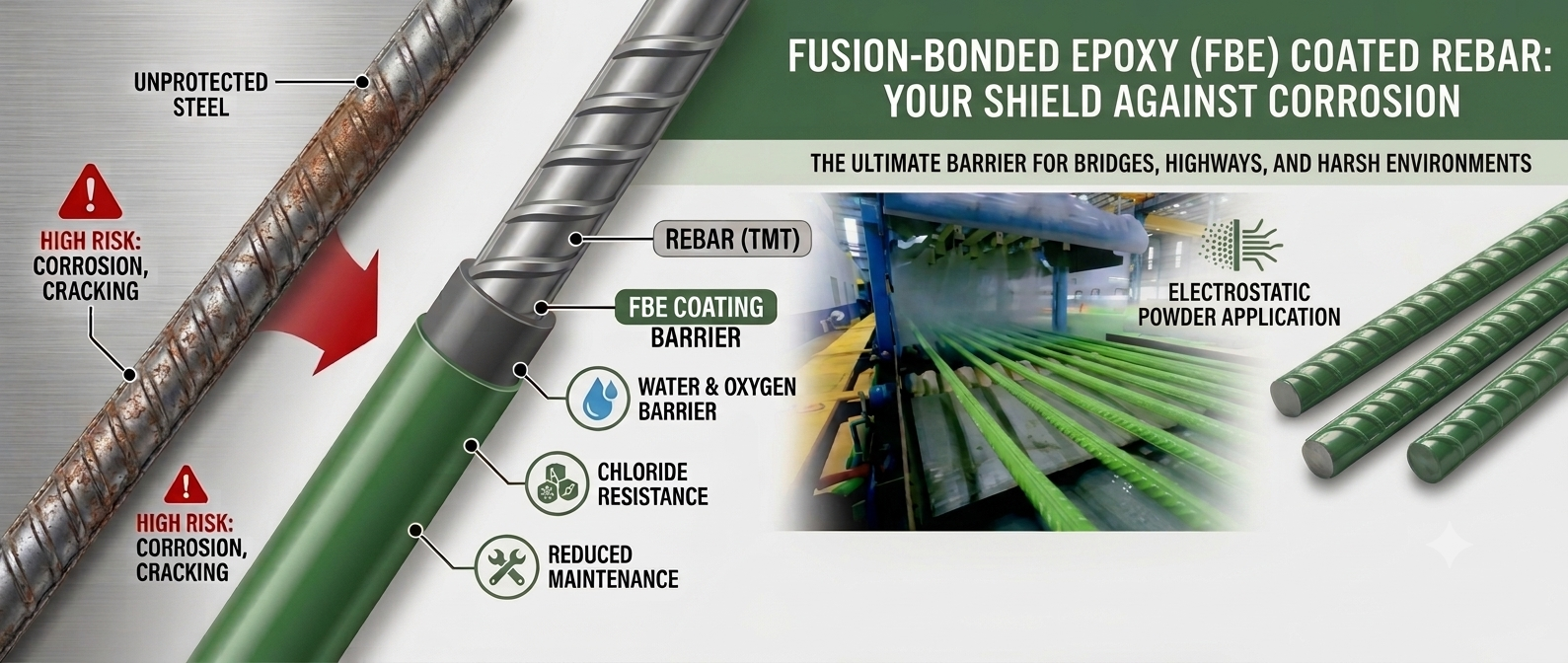
Fusion-bonded epoxy-coated rebar is widely used in construction projects where corrosion protection is the top priority. The rebar is epoxy coated, a special coating that acts as a barrier between the steel surface and the harmful elements in the environment such as moisture, oxygen, salts and chemicals. They are widely used in bridges, highways, marine structures, flyovers, parking facilities and other infrastructure projects.
But buying epoxy-coated rebar isn’t just a matter of picking a size or quantity. Buyers must also check the quality of the steel and the performance of its protective coat. Poor coating quality, uneven application, pinholes and weak adhesion reduce corrosion protection and affect the long-term durability of concrete structures.
Therefore, quality testing is important before accepting and purchasing fusion-bonded epoxy coated rebar. In this article we will talk about the main quality tests and inspection points that the buyers should consider.
VISUAL INSPECTION OF THE EPOXY COATINGS
One of the first and easiest quality checks that a buyer should make is a visual inspection. This helps to find visible defects in coatings before the material is accepted on the construction site.
Buyers should look for during the inspection:
- Cracks, scratches, cuts, peeling of coating
- Coating thickness non uniform or exposed steel surfaces
- Visible surface defects such as bubbles, blisters, etc
- Damage in transit or handling
- Excessively built-up coating or irregular coated areas
THICKNESS TEST OF COATING
One of the most important factors in the quality and consistency of epoxy protection is the thickness of the coating. If the coating is too thin, it may not provide the necessary barrier to corrosive elements. Also, too much thickness can create problems if it affects handling, bending or other performance requirements.
Things to check as a buyer:
- Coating thickness according to the applicable standard
- Whether the thickness is reasonably uniform along the bar
- If measurements are made at different locations
- If the testing equipment is properly calibrated
- Whether the inspection report has actual measurement results
HOLIDAY DETECTION TESTING
The holiday detection test is used to detect small holes, gaps or discontinuities in the epoxy coating. These defects are often called holidays because they expose the steel surface beneath the coating.
Remember a few important things:
- Verify that the coating has been tested for pinholes and discontinuities
- Confirm test equipment is suitable for the thickness of the coating
- Make sure the test is performed to the relevant standard
- Make sure any defects found are repaired correctly
- Get the holiday detection test report from the manufacturer
ADHESION TEST FOR COATINGS
The adhesion test is to test the adhesion of the epoxy coating on the steel surface. Good adhesion is required to keep the protective layer in place during transport, handling, bending and installation.
Buyers should verify:
- Whether the coating stays well bonded to the steel
- If there is any sign of peeling or separation
- Whether the adhesion test is performed according to the relevant test procedure
- if the manufacturer provides documented test results
IMPACT RESISTANCE TEST
Fusion-bonded epoxy-coated rebar can be subjected to impacts during loading and unloading, transportation and construction activities. Impact Resistance Test This test is used to evaluate the capacity of the coating to resist sudden mechanical force.
Please note the following for buyers:
- Confirm the coating is capable of meeting impact requirements of the applicable standard
- Check for cracks, chips or coating separation after testing
- Ensure that test conditions and results are properly documented
- Avoid easy damage of the coating in the normal handling
BEND TEST AND FLEXIBILITY
Reinforcement bars are often bent into various forms as per structural drawings. Thus the epoxy coating must be flexible enough to survive the bending operations required without excessive cracking or separation.
Buyers should check during this inspection:
- Cracks appear on the coating during bending
- Is the epoxy layer still properly attached
- when the test satisfies the specified bending requirements
- Whether the bar meets the standards required for fabrication and installation
TESTING FOR ABRASION RESISTANCE
Abrasion resistance means how well the coating can resist surface wear from rubbing and repeated touching of other materials.
On construction sites reinforcement bars may rub against lifting equipment, storage supports, transport vehicles and other bars. This friction can damage a weak or poorly applied finish.
Buyers should look for:
- If the coating meets the criteria for abrasion resistance
- If the test is performed using an approved method
- If you see heavy wear or exposed steel
- Assisting the manufacturer in delivering quality documentation
SALT SPRAY AND CORROSION RESISTANCE TESTS
One of the primary reasons for use of fusion-bonded epoxy-coated rebar is the reduction of corrosion in reinforced concrete structures. Therefore, corrosion resistance is an important factor as regards the quality of the coating.
Buyers should seek out:
- Documented corrosion resistance test data.
- Description of the test method and the exposure conditions
- Signs of coating damage, rusting or deterioration after testing
- Compliance with applicable product and project requirements
MECHANICAL PROPERTY TESTING & STEEL GRADE
Epoxy coating protects the reinforcement from corrosion, but the steel itself has to meet the strength and mechanical performance requirements.
Buyers should not only look at the coating. They will also have to check the quality of the underlying TMT reinforcement steel.
Important checks include:
- Tensile strength
- Yield strength
- Elongation
- Bend test
- Chemical composition
CHECK THE QUALITY CERTIFICATES AND INSPECTION REPORTS
In addition to physical testing, buyers should always request quality papers from the manufacturer. These documents contain information about the material, coating process and test results.
We also comply with multiple quality accreditations like the ISO 45001:2018, ISO 9001:2015, ISO 14001: 2015 and many more. We have also implemented Indian Standard 13620:1993 and American Standard A775/A775M of testing in our labs.
Check the following documents before accepting an order:
- Mill Test Certificate
- Test Report of Coating
- Holiday Detection Report
- Certificate of Quality from the Manufacturer
- Inspection and Shipping Records
The buyer should check that the certificates correspond to the actual lot of rebar being delivered.
CHEMICAL COMPOSITION LIMITS OF DIFFERENT GRADES OF STEEL
The table presents the maximum permissible percentage of key chemical constituents in different grades of steel. These limits help ensure the required strength, ductility, and quality of reinforcement steel.
| Constituent | Fe 415 | Fe 415D | Fe 500 | Fe 500D | Fe 550 | Fe 550D | Fe 600 |
|---|---|---|---|---|---|---|---|
| Carbon | 0.30 | 0.25 | 0.30 | 0.25 | 0.30 | 0.25 | 0.30 |
| Sulphur | 0.060 | 0.045 | 0.055 | 0.040 | 0.055 | 0.040 | 0.040 |
| Phosphorus | 0.060 | 0.045 | 0.055 | 0.040 | 0.050 | 0.040 | 0.040 |
| Sulphur and Phosphorus | 0.110 | 0.085 | 0.105 | 0.075 | 0.100 | 0.075 | 0.075 |
CONCLUSION
Quality testing is a must when buying fusion-bonded epoxy-coated rebar for construction projects Each check is used to assess the reliability of the protective coating.
Selecting the appropriate epoxy coated rebar that meets the standards can help to prevent corrosion, enhance structural longevity, and contribute to the overall success of your construction projects. A thorough quality check prior to accepting the material is a practical step toward building stronger and more durable infrastructure.