
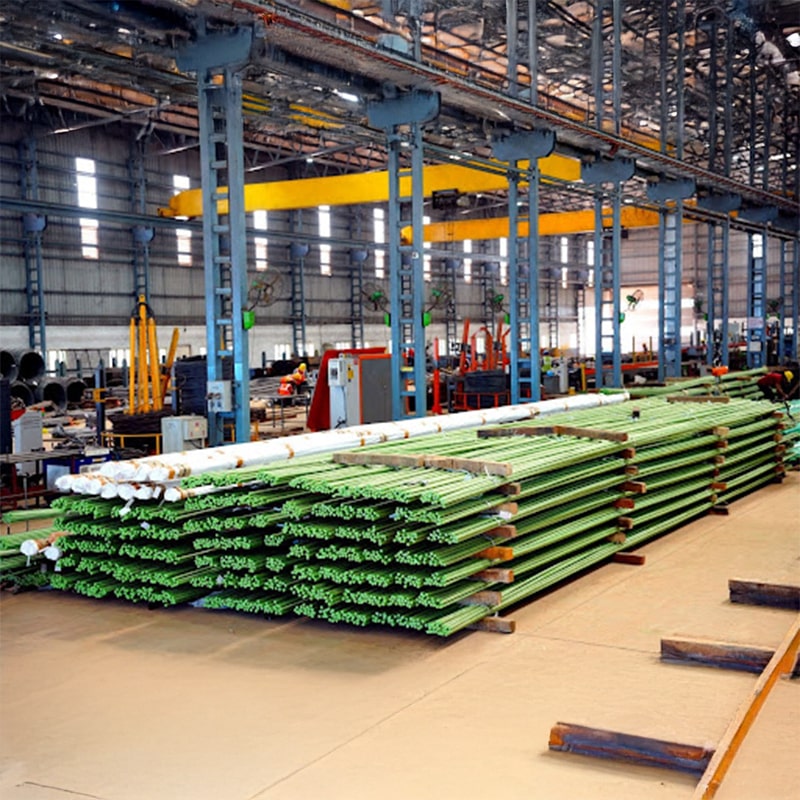
When it comes to the construction sphere of the present day, the backbone of any building is the skeleton (the framework of reinforced concrete) that is the key to its strength, durability, and safety. The core of this framework is the Thermo-Mechanically Treated (TMT) steel bar, which is a new material that has become the newcomer to the gold standard of reinforcement. However, TMT bars are not equal. The engineers, architects and builders should be aware of the various type of cement which is determined mainly by its grade and certain characteristics so that the integrity of their work can be verified.
The production of TMT bars follows an advanced procedure where rapid water cooling is done after the hot-rolled bar exits the last rolling mill. Remarkable structure is formed in this process: a strong outer rim which is hard, and an inner core which is very soft and ductile. This is the best-in-class combination of high strength and better elongation that distinguishes TMT bars with those coming before them. These differences in this process and also in the chemical structure lead to dissimilar grades and types of TMT bars.
CLASSIFICATION BY GRADES: THE MEASURE OF STRENGTH
TMT bars can be most basically categorised by their grade which refers to the lowest yield stress the bar can absorb and this is quantified in Megapascals (MPa). The grade is a straight measure of the strength of the bar and is labelled as the prefix Fe (Ferrous) with the number attached after it.
FE-415: THE STANDARD WORKHORSE
Fe-415 is an example of the most popular TMT bars used in the construction industry especially in small to medium-size projects.
- Properties: The figure 415 represents a minimum yield strength of 415Mpa. This grade provides a great strength to ductility (elongation) balance. It is easily bendable on-site due to its high elongation without incurring micro-cracks.
- Applications: Perfect in the residential building, low rise buildings as well as in areas where the seismic activity is low. It is best suited in the construction of individual homes, bungalows and small complexes of apartments where the feature of extreme tensile strength is not the main one.
FE-500: THE INDUSTRY BENCHMARK
The most common grade is known as Fe-500 and is employed in a wide range of construction works in India and a wide range of countries.
- Properties: It has a lowest yield strength of 500 MPa, which is about 20 per cent stronger than Fe-415. It has a good ductility and weldability and is therefore a strong and dependable material to be used in the most challenging applications.
- Applications: Used extensively in the construction of multi-storey buildings, bridges, industrial structures, and heavy-duty factories. Its superior strength allows for a slight reduction in the quantity of steel used for the same load-bearing capacity, offering economic and structural efficiency.
FE-550: THE HIGH-STRENGTH SPECIALIST
Fe-550 is a high-strength TMT bar designed for projects where load-bearing demands are significantly higher.
- Properties: This grade offers a yield strength of 550 Mpa. Although it is stronger, its ductility is slightly lower than Fe-500; this needs to be considered during the structural design, particularly in areas that are prone to earthquakes.
- Applications: Reserved mostly with large-scale industrial applications, heavy-load structures such as bridges and flyovers, high-rise towers, as well as foundations of machinery which cause dynamic loads. It is the one being preferred when it is highly important to maximise the strength-to-weight ratio.
FE-600: THE PREMIUM GRADE FOR CRITICAL STRUCTURES
Fe-600 represents the upper echelon of TMT bar strength and is used for the most demanding and specialised construction.
- Properties: Boasting a minimum yield strength of 600 MPa, this grade offers maximum tensile strength. Its use requires sophisticated engineering design to account for its higher strength and correspondingly lower elongation.
- Applications: Designated to use when constructing mega-infrastructure projects like skyscrapers, long-span bridges, underground metro stations, nuclear power facilities and buildings in areas with high seismic activity. It does not compromise on the end steel tonnage needed since its use can save a lot of money.
SPECIALISED TYPES OF TMT BARS
Beyond grades, TMT bars are also engineered with specific properties to combat environmental challenges.
TMT Bars with Corrosion Resistance: Steel reinforcement is the major factor that leads to the degradation of concrete structures particularly where there is the aggressive environment.
- Properties: These bars are manufactured with controlled chemistry with an augmented level of corrosion resistant components like Copper (Cu), Chromium (Cr) and Phosphorus (P). Written in this manner, to specifications, even, indeed, to IS-1786, this composition significantly slows down the oxidation process.
- Applications: Indispensable for construction in coastal areas, marine environments, water treatment plants, sewage systems, and industrial zones with high chemical pollution.
Earthquake-Resistant TMT Bars: In areas that are prone to seismic, the capacity of a construction to bend and absorb energy without failure is crucial.
- Properties: These are generally special grades such as Fe-500D and Fe-550D, the D indicating Ductile. They have a greater proportion of elongation (approximately 18 percent or above) and an unquestioned ratio of yield strength to tensile strength, which guarantees them a significant warning time as they experience a high degree of deformation before breaking down.
- Applications: Mandatory for all construction in seismic Zones III, IV, and V. Used in high-rises, hospitals, schools, and other critical infrastructure in earthquake-prone areas.
Low-Carbon TMT bars: As sustainable building trends become increasingly important, the trend towards low-carbon TMT bars is becoming increasingly popular.
- Properties: The production of these bars is done with high-end technology which lowers the amount of carbon in them and the overall amount of carbon footprint associated with the manufacturing process without reducing the mechanical properties.
- Applications: Applied in the projects which need certifications of green buildings, such as LEED (Leadership in Energy and Environmental Design) or GRIHA, which attracts developers and clients interested in environmentally-friendly projects.
CHOOSING THE RIGHT TYPE
The selection of the appropriate TMT bar is a critical engineering decision that depends on a multitude of factors:
Type of Structure: A single-story house may use Fe-415, while a 50-storey skyscraper will require Fe-550 or Fe-600.
Geographical Area: Corrosion free bars are required in projects along the coastal area, whereas high-ductility grades are required in seismic areas.
Budget and Design Efficiency: Higher grades may cut down on the total tonnage of steel and this may offset their high cost per tonne.
The steel bars of TMT now have a host of specialised and high-performance material, which have been important in enabling the bold and strong structures of the 21st century. The construction industry will be in a position to build safer, stronger and more sustainable habitats in future knowing the different types and their specific purpose.
Related Link: What is the Difference Between a TMT Bar and Normal Bar?
-
209, Gowra Fountainhead, Patrika Nagar
Madhapur, Hyderabad - 500081 - Phone: +91 9100073039 Phone: +91 8121004773
- nsepoxy@gmail.com Website: www.nagarjunagroup.com
- Sitemap
 Contact us
NS Epoxy stands as the frontrunner in TMT manufacturing, committed to constant innovation and research. Our focus is to ensure our product technology remains cutting-edge, precisely tailored to meet client's requirements.